


In this article
- What is Jacobson relaxation?
- How progressive muscle relaxation works
- Benefits of Jacobson’s method
- When to take care
- Preparing for practice
- Jacobson exercises: a step-by-step guide
- A short Jacobson relaxation practice
- Jacobson relaxation for anxiety and stress
- Jacobson’s method before bed
- Common mistakes
- Frequently asked questions
- Practices to release muscle tension
Jacobson relaxation
Sometimes we realise just how tense we are only when we notice raised shoulders, a clenched jaw, a furrowed forehead or heaviness in the back. The working day is over, but the body remains ready for the next task and cannot fully settle into rest.
Jacobson relaxation is a technique of tensing and relaxing different muscle groups in sequence. It helps you become more aware of your body, notice accumulated tension and gradually let it go. You can practise sitting or lying down, at home, before bed or after a difficult day. You do not need special equipment, good flexibility or experience with yoga.
What is Jacobson relaxation?
Jacobson progressive muscle relaxation was developed by American physician Edmund Jacobson in the first half of the twentieth century. His approach was based on the idea that emotional tension is often accompanied by muscle tension, and that learning to relax the body deliberately can support an overall sense of calm.
During the practice, you work through individual muscle groups: first you deliberately tense them for a few seconds, then release the effort completely and observe the change in sensations.
The method is also called Jacobson progressive relaxation or neuromuscular relaxation. Each name refers to the same basic principle: moving from controlled tension to deeper relaxation.
How progressive muscle relaxation works
The central part of the technique is the contrast between two states, rather than muscle tension itself. After a brief effort, relaxation becomes easier to notice: you may feel warmth, heaviness, softness, gentle tingling or a reduction in familiar stiffness.
Gradually, you learn to recognise bodily signals earlier. For example, you may notice that while working you clench your teeth, raise your shoulders, tense your abdomen or hold your hands tightly. Once you become aware of these habits, it is easier to let go of unnecessary effort.
Jacobson’s original method was fairly lengthy and involved detailed work with many muscles. Adapted versions are more common today, combining muscles into a few larger groups. A full practice usually takes 10–20 minutes; a short version takes about 3–5 minutes.
Benefits of Jacobson’s method
Progressive muscle relaxation is an accessible way to relax the body and manage everyday tension. Research suggests that it may help reduce perceived stress and anxiety. It remains an additional tool and does not replace assessment, psychotherapy or treatment.
- Helps you notice muscle tension. You learn to identify areas that remain tense even at rest.
- Encourages relaxation. Working through the muscles helps you switch from constant activity to rest.
- Brings attention back to the body. The practice can be useful when it is difficult to step back from a stream of thoughts and focus on the present moment.
- Helps you prepare for sleep. Quiet relaxation while lying down can become part of an evening routine.
- Works as an independent practice. Once you have learned the sequence, it is easy to follow without special equipment.
- Develops self-regulation skills. Over time, you can use individual elements during the day to relax your shoulders, face, hands or abdomen.
A systematic review of research into progressive muscle relaxation in adults found positive results for stress and anxiety, although the effect may differ between people. View the practice as one form of self-care, rather than a universal solution.
When to take care
Jacobson relaxation is generally considered gentle, but tensing muscles should never cause pain. Skip any area with an injury, inflammation, significant soreness or a tendency to cramp.
If you have recently had surgery, have muscle or joint conditions, significant chronic pain, activity restrictions during pregnancy or are recovering from illness or injury, discuss the practice with a doctor or rehabilitation professional first.
If you experience sharp pain, numbness, dizziness, shortness of breath or increased anxiety, stop and return to ordinary breathing. Seek professional support for recurring panic attacks, an anxiety disorder or persistent insomnia.
Preparing for practice
For your first full session, choose a quiet setting where you will not be interrupted for 10–15 minutes. Lie on your back or sit in a stable armchair with support for your back.
Before you begin:
- loosen tight clothing and remove your shoes;
- put away your phone and other distractions;
- let your arms rest freely beside your body or on your thighs;
- close your eyes only if that feels comfortable;
- take two or three calm breaths;
- avoid breathing too deeply or in an unfamiliar way.
Use the same rhythm for each muscle group: gradually create moderate tension, hold it for about 5 seconds, then relax completely for 10–15 seconds. Keep breathing calmly and never push the effort to the point of pain, shaking or cramp.
Jacobson exercises: a step-by-step guide
You can work from top to bottom or bottom to top. The following sequence moves from the hands to the feet. Focus on the sensations after you release tension, rather than on how strongly you tense the muscles.
1. Hands and forearms
Make fists. Notice tension in your fingers, hands and forearms, without pressing your nails into your palms. After 5 seconds, open your fingers fully and relax for 10–15 seconds. Notice any warmth, heaviness or gentle tingling in your arms.
2. Shoulders and arms
Bend your elbows and gently tense the arm muscles. Then raise your shoulders towards your ears without strongly drawing in your head. After a few seconds, lower your shoulders and let your arms rest freely. Notice how the shoulder area becomes heavier and softer.
3. Face
Raise your eyebrows slightly and wrinkle your forehead. Then gently close your eyes more firmly and carefully tighten your lips and jaw, without putting strong pressure on your teeth. Relax your face completely: smooth your forehead, release your eyelids, separate your teeth and let your tongue rest freely in your mouth.
If it is difficult to focus on the whole face at once, divide the exercise into three stages: the forehead, the area around the eyes and the jaw.
4. Neck
Be especially gentle with your neck. Do not tip your head back or make sudden movements. You can press the back of your head very lightly into its support, or move your chin slightly towards your chest until you feel a small amount of tension. Release the effort after 3–5 seconds.
Skip this part if you have pain, dizziness or a cervical spine condition.
5. Chest, back and abdomen
Gently draw your shoulder blades together as if opening your chest a little. Do not arch your back or hold your breath. After 5 seconds, release the effort and notice how your back feels heavier.
Then tense your abdominal muscles slightly, as though preparing to cough. Hold for a few seconds and relax your abdomen completely. Allow your breathing to move freely.
6. Buttocks and thighs
Squeeze your buttocks and lightly tense the fronts of your thighs at the same time. Do not lift your pelvis or force your lower back into the floor. Relax after 5 seconds and notice how your thighs become heavier.
7. Lower legs
Carefully draw your toes towards you to feel tension in the lower legs. Do not move so far that the muscles cramp. Release your feet and let your legs relax completely. Skip this part if your lower-leg muscles often cramp.
8. Feet
Curl your toes gently, notice tension in the feet, then spread them out. Observe the sensations in your toes, the arches of your feet and your heels.
After the sequence, remain sitting or lying quietly for about a minute. Mentally move your attention from your face to your feet. If an area still feels tense, you do not necessarily need to tense it again: try a calm exhale and allow the muscles to soften.
To finish, move your fingers and toes, stretch gently and open your eyes slowly. If you were lying down, first roll onto your side, then get up.
A short Jacobson relaxation practice
When time is limited, combine the muscles into four large groups. This version takes about 3–5 minutes and works well as a daytime break.
- Make fists and tense your arms.
- Raise your shoulders and gently tense your face.
- Tense your abdomen, back and buttocks.
- Tense your thighs, lower legs and feet.
Hold each group for about 5 seconds, then relax it for 10–15 seconds. Even in the short version, take your time: the purpose is to notice the transition from effort to relaxation.
Jacobson relaxation for anxiety and stress
When you feel anxious, your body often responds before you become aware of your state: breathing speeds up, your shoulders and abdomen tense, and your hands and jaw tighten. Progressive muscle relaxation directs attention towards specific bodily sensations and helps you release unnecessary muscle effort in sequence.
Practise Jacobson’s method regularly at calm times so the sequence becomes familiar. Then, when stress begins to build, it will be easier to use a short version to relax the areas holding the most tension.
The technique does not suit everyone during a panic attack. Focusing on the body helps some people regain a sense of control, but may increase anxiety for others. If you feel worse, do not force yourself to continue. For recurring panic attacks or an anxiety disorder, relaxation can be used only as an addition to support from a doctor or psychotherapist.
Jacobson’s method before bed
In the evening, you can practise lying in bed. Dim the lights, put away your phone and work through the main muscle groups from your face to your feet, or from your feet to your face.
You do not need to make yourself sleep or check how quickly you are falling asleep. The aim is to help your body move from activity to rest. When you finish, you can keep your eyes closed and stay in bed: let go of control over your breathing and remain in a comfortable position.
If insomnia persists, regularly affects your wellbeing or comes with pronounced daytime sleepiness, a relaxation technique alone is not enough. Discuss the problem with a healthcare professional.
Common mistakes
- Tensing muscles as hard as possible.
- Continuing through pain or cramp.
- Holding your breath while tensing.
- Moving too quickly between muscle groups.
- Reducing the relaxation phase to just a few seconds.
- Trying to force all thoughts to stop.
- Expecting complete relaxation after the first session.
- Tensing injured or painful areas.
The relaxation phase should be longer than the tension phase. These are the seconds in which you learn to notice how your muscles change. Some days the difference will be obvious; on others it may be barely perceptible. Both are normal.
Frequently asked questions
What is Jacobson relaxation?
It is a technique in which you tense and relax different muscle groups in sequence, paying attention to the difference between tension and rest.
How do I practise Jacobson relaxation?
Create moderate tension in a chosen muscle group for about 5 seconds, then relax it completely for 10–15 seconds. Keep breathing calmly and work through the body in sequence.
How long does the practice take?
A full progressive muscle relaxation session usually takes 10–20 minutes. A short version using four large muscle groups can be completed in 3–5 minutes.
How often can I do Jacobson exercises?
When learning, try one session a day for a week. Then use a full or short practice as needed, provided it does not cause discomfort.
Does Jacobson relaxation help with anxiety?
It may help reduce muscle tension and perceived stress. It does not replace professional support for an anxiety disorder or recurring panic attacks.
Can I use the method during a panic attack?
A short practice helps some people turn their attention to the body, but focusing on sensations can be uncomfortable for others. Stop if your anxiety increases.
Can I practise before bed?
Yes. You can practise lying in bed as part of an evening routine. You do not need to get up or open your eyes afterwards.
Do I need audio or video?
Voice guidance can help you follow the sequence during your first sessions. Once you know the stages, the method is easy to practise independently. Music is optional too.
What should I do if a muscle cramps?
Release the tension immediately and skip that area. Discuss recurring cramps or pain with a doctor.
Practices to release muscle tension
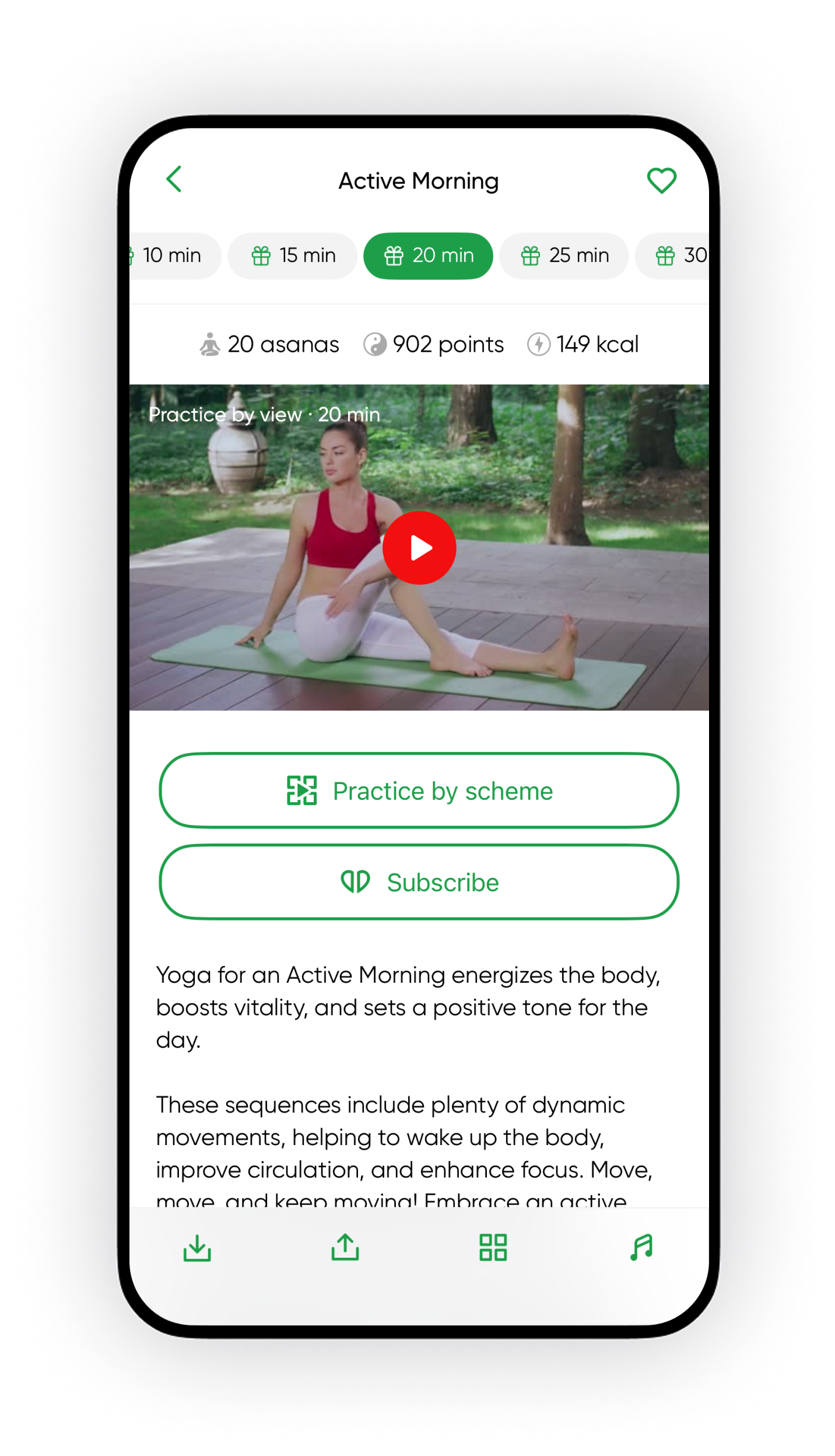
After relaxation, you can add gentle movement, stretching and calm breathing. Choose a lesson with a duration that suits you:


You do not need to relax perfectly. Pause for a few minutes, notice how your body feels and gradually let go of unnecessary effort.





Comments
+ leave yoursThis article has no comments yet, be the first